I talk to a lot of people, and they often told me that they are overwhelmed. In the spirit of problem solving, I find it interesting to take a look at this common condition using the IDOAIM framework.
Identify the reason: Do we want to stop feeling overwhelmed? This sounds like a silly question, but I found some people "enjoy" being overwhelmed. It gives them opportunity to talk, to complain, to be the center of attention. Yes, I agree that it is sick to be that way, but it is a sick fact. So, before moving forward, let's see if we really want to stop being overwhelmed. For example: we have been missing a good peaceful sleep because of stress and sleep is really, really something of value for us.
Once we identify the reason, the stronger reason the better, of working on this problem, we move on.

Tampilkan postingan dengan label problem solving series. Tampilkan semua postingan
Tampilkan postingan dengan label problem solving series. Tampilkan semua postingan
Mei 16, 2012


April 10, 2012
Problem Solving Series 7 Make the Change Stick
Allright, here we are. The last step of solving our problem.
We have spent so much time, money, effort in getting to the root cause of the problem, so it only make sense if we make sure it does not return, right?
The truth is, over 50% of problems solved tend to recur.There are several reasons why this happens:
1. We are still solving the symptom of a deeper problem.
Usually when this happens, our solutions lead to undesired effects popping out in another area or another part of the process. It could also be identified if our solution puts 'pressure' in the process/area of concerns. Dig deeper in the root cause analysis or find another layer of assumptions to break to get away from this situation.
2. No buy-ins from stakeholders.
We know this to be the case when the stakeholders simply do not commit to the change. When solutions are not followed without any proof of undesired effects or 'pressure', it is time to have quality time with the stakeholders to get their buy-ins. A better way to fix this is to get them involved from the beginning. On extreme cases where they simply refuse to change, we need to create a burning platform where they just have no other way but follows. This can be done by creating environment of crisis - either as an organization or as an individual through his/her direct superior.
3. No understanding of the solutions
This happens when our prescribed solutions are not followed properly. Trainings, socialization, and close monitoring in the short term and long term will fix this.
Usually, we know this step will be successful or not way earlier in the project - The best way to handle problems here is to handle them when they are small and new. As soon as we identify no buy-ins or lack of communication, we need to address it even before we go into Step 7.
We have spent so much time, money, effort in getting to the root cause of the problem, so it only make sense if we make sure it does not return, right?
The truth is, over 50% of problems solved tend to recur.There are several reasons why this happens:
1. We are still solving the symptom of a deeper problem.
Usually when this happens, our solutions lead to undesired effects popping out in another area or another part of the process. It could also be identified if our solution puts 'pressure' in the process/area of concerns. Dig deeper in the root cause analysis or find another layer of assumptions to break to get away from this situation.
2. No buy-ins from stakeholders.
We know this to be the case when the stakeholders simply do not commit to the change. When solutions are not followed without any proof of undesired effects or 'pressure', it is time to have quality time with the stakeholders to get their buy-ins. A better way to fix this is to get them involved from the beginning. On extreme cases where they simply refuse to change, we need to create a burning platform where they just have no other way but follows. This can be done by creating environment of crisis - either as an organization or as an individual through his/her direct superior.
3. No understanding of the solutions
This happens when our prescribed solutions are not followed properly. Trainings, socialization, and close monitoring in the short term and long term will fix this.
Usually, we know this step will be successful or not way earlier in the project - The best way to handle problems here is to handle them when they are small and new. As soon as we identify no buy-ins or lack of communication, we need to address it even before we go into Step 7.
November 07, 2011
Problem Solving Series 6 - Improve the Situation
Here we are, almost done.
The next step after getting a good understanding of the source and reason of our problems, we then have to move forward to finding way(s) to improve the situation. I intentionally did not use 'solve the problem' here, because in many cases, a problem can not necessarily be solved immediately, but the situation can always be improved.
The next step after getting a good understanding of the source and reason of our problems, we then have to move forward to finding way(s) to improve the situation. I intentionally did not use 'solve the problem' here, because in many cases, a problem can not necessarily be solved immediately, but the situation can always be improved.
Oktober 13, 2011
Problem Solving Series 5b - Analyze the Problem
This is part 2 of Analyze
We have talked about a nifty tool where we can compare two continuous factors and find out if there is any relationship between them.
Now what about we are faced with two sets of data from two categories, such as male and female? This is when we can use the next tool.
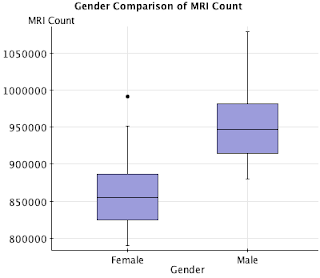
b. Box plots: Here are a sample of Box Plots - comparison of MRI count (an indicator of brain size) between male and female
Now that we have all these tools, what next? The next steps is to have an open mind. Train your mind to think creatively through getting rid of any prejudgment and objectively look at the facts separately from the language (e.g. an animal with long ears is not necessarily a rabbit, so if it eats meat, don't think it's a rabid rabbit), and separately from the past (e.g. a wireless communication device is sci-fi material in the 60s, but it does not mean it is not possible now). In conjunction to this, we need look for more potential influencing factors than what we normally pick. For example, if we want to improve our financial health, make sure we look beyond getting a pay raise or cutting back Starbucks coffee. There are plenty of other factors we need to look into.
Finally, as in almost anything in life, getting many flying hours is the key to getting a good grip of problem analysis. So, the only advice I have is, do it, practice, repeat.
Good luck.
We have talked about a nifty tool where we can compare two continuous factors and find out if there is any relationship between them.
Now what about we are faced with two sets of data from two categories, such as male and female? This is when we can use the next tool.
b. Box plots: Here are a sample of Box Plots - comparison of MRI count (an indicator of brain size) between male and female

As you can see, it is easy to note that Male has higher MRI count than female. To find out more about how to create Boxplots, click here.
Finally, as in almost anything in life, getting many flying hours is the key to getting a good grip of problem analysis. So, the only advice I have is, do it, practice, repeat.
Good luck.
September 06, 2011
Problem Solving Series #5a - Analyze the Problem
Allright, now we have arrived at the most fun part of the IDOAIM problem solving steps: Analysis.
There are literally hundreds of ways to analyze your problem, but essentially here are key important features that you need to answer:
First of all, everything, I mean everything, has causes and effects. Your data collection, your site visits, and your analysis should discover what causes which effects. There are several simple tools to analyze numerical data and answer whether a particular variable affects a particular output:
a. Scatter plot : If you have a numeric variable that is continuous, i.e. you can have any real numbers that spans a particular range, preferably a very wide range, and if you have an output in question that is also continuous and spans wide, you may want to plot these pairs into a simple scatter plot and see if small value of the input has a small value of output. Here is an example:
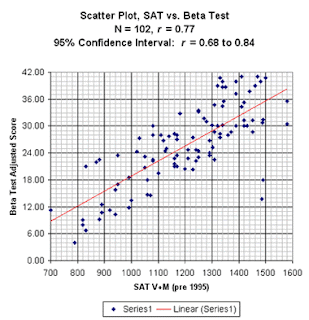 Courtesy of Jessica Hannah's Map Catalog - jessicahannahmaps.blogspot.com
In that scatter plot, whatever SAT is, it surely affects Beta Test score, whatever that is. So you don't really need to know what they are to know they are related. Nifty, right?
Don't go too fast!
It is still a good idea to understand the logic behind the relationship, because sometimes there is this thing called autocorrelation, which we shouldn't dwell too much here. (If you insist on an explanation, check this out, a simple illustration).
to be continued...
There are literally hundreds of ways to analyze your problem, but essentially here are key important features that you need to answer:
First of all, everything, I mean everything, has causes and effects. Your data collection, your site visits, and your analysis should discover what causes which effects. There are several simple tools to analyze numerical data and answer whether a particular variable affects a particular output:
a. Scatter plot
: If you have a numeric variable that is continuous, i.e. you can have any real numbers that spans a particular range, preferably a very wide range, and if you have an output in question that is also continuous and spans wide, you may want to plot these pairs into a simple scatter plot and see if small value of the input has a small value of output. Here is an example: 
In that scatter plot, whatever SAT is, it surely affects Beta Test score, whatever that is. So you don't really need to know what they are to know they are related. Nifty, right?
Don't go too fast!
It is still a good idea to understand the logic behind the relationship, because sometimes there is this thing called autocorrelation, which we shouldn't dwell too much here. (If you insist on an explanation, check this out, a simple illustration).
to be continued...
Mei 29, 2011
Problem Solving Series #4 Observe the Situation

Mei 04, 2011
Problem Solving Series #3 - Define the Problem

I am going to open with an interesting quote from Albert Einstein:
"No problem can be solved from the same level of consciousness that created it."
It is important to first understand the problem at a higher level than the problem itself.
Einstein said if he was given an hour (sixty minutes) to solve a problem, he will spend fifty five minutes understanding and defining the problem and only five minutes to solve it. Yes. Problem definition is that important.
How does one go about defining his or her problem? Here are three steps of problem definition:
Langganan:
Postingan (Atom)