I talk to a lot of people, and they often told me that they are overwhelmed. In the spirit of problem solving, I find it interesting to take a look at this common condition using the IDOAIM framework.
Identify the reason: Do we want to stop feeling overwhelmed? This sounds like a silly question, but I found some people "enjoy" being overwhelmed. It gives them opportunity to talk, to complain, to be the center of attention. Yes, I agree that it is sick to be that way, but it is a sick fact. So, before moving forward, let's see if we really want to stop being overwhelmed. For example: we have been missing a good peaceful sleep because of stress and sleep is really, really something of value for us.
Once we identify the reason, the stronger reason the better, of working on this problem, we move on.

Tampilkan postingan dengan label IDOAIM. Tampilkan semua postingan
Tampilkan postingan dengan label IDOAIM. Tampilkan semua postingan
Mei 16, 2012


September 06, 2011
Problem Solving Series #5a - Analyze the Problem
Allright, now we have arrived at the most fun part of the IDOAIM problem solving steps: Analysis.
There are literally hundreds of ways to analyze your problem, but essentially here are key important features that you need to answer:
First of all, everything, I mean everything, has causes and effects. Your data collection, your site visits, and your analysis should discover what causes which effects. There are several simple tools to analyze numerical data and answer whether a particular variable affects a particular output:
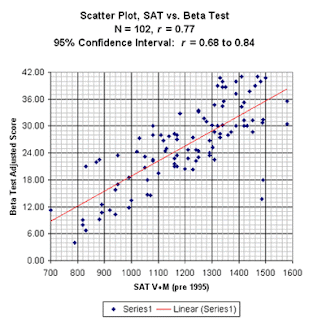
a. Scatter plot : If you have a numeric variable that is continuous, i.e. you can have any real numbers that spans a particular range, preferably a very wide range, and if you have an output in question that is also continuous and spans wide, you may want to plot these pairs into a simple scatter plot and see if small value of the input has a small value of output. Here is an example:
 Courtesy of Jessica Hannah's Map Catalog - jessicahannahmaps.blogspot.com
In that scatter plot, whatever SAT is, it surely affects Beta Test score, whatever that is. So you don't really need to know what they are to know they are related. Nifty, right?
Don't go too fast!
It is still a good idea to understand the logic behind the relationship, because sometimes there is this thing called autocorrelation, which we shouldn't dwell too much here. (If you insist on an explanation, check this out, a simple illustration).
to be continued...
There are literally hundreds of ways to analyze your problem, but essentially here are key important features that you need to answer:
First of all, everything, I mean everything, has causes and effects. Your data collection, your site visits, and your analysis should discover what causes which effects. There are several simple tools to analyze numerical data and answer whether a particular variable affects a particular output:
a. Scatter plot
: If you have a numeric variable that is continuous, i.e. you can have any real numbers that spans a particular range, preferably a very wide range, and if you have an output in question that is also continuous and spans wide, you may want to plot these pairs into a simple scatter plot and see if small value of the input has a small value of output. Here is an example: 
In that scatter plot, whatever SAT is, it surely affects Beta Test score, whatever that is. So you don't really need to know what they are to know they are related. Nifty, right?
Don't go too fast!
It is still a good idea to understand the logic behind the relationship, because sometimes there is this thing called autocorrelation, which we shouldn't dwell too much here. (If you insist on an explanation, check this out, a simple illustration).
to be continued...
Mei 29, 2011
Problem Solving Series #4 Observe the Situation

Mei 04, 2011
Problem Solving Series #3 - Define the Problem

I am going to open with an interesting quote from Albert Einstein:
"No problem can be solved from the same level of consciousness that created it."
It is important to first understand the problem at a higher level than the problem itself.
Einstein said if he was given an hour (sixty minutes) to solve a problem, he will spend fifty five minutes understanding and defining the problem and only five minutes to solve it. Yes. Problem definition is that important.
How does one go about defining his or her problem? Here are three steps of problem definition:
Langganan:
Postingan (Atom)